Rule-of-law scores fell in 26 of the 40 European countries with comparable data between 2021 and 2026, and the four Nordic leaders were among them: Denmark, Norway, Finland and Sweden each lost ground, according to a Visual Capitalist ranking built on the World Justice Project's latest index.
It is not only a European problem. The WJP's 2026 index, released October 21, covers 143 countries and found declines outnumbering improvements for the ninth straight year, 62% to 38%. The group said the drop in its measure of constraints on government powers was driven by weaker non-governmental checks, and that judicial limits on government power fell in 63% of countries.
Inside Europe, Russia fell 0.062 points to 0.401, the steepest drop on the continent, followed by Georgia (0.036), Serbia (0.032) and Belarus (0.031). Latvia (up 0.031) and Lithuania (up 0.028) improved the most. Germany slipped 0.010 to 0.830, France 0.004 to 0.716 and the UK 0.007 to 0.778.
Using the World Justice Project's Rule of Law Index 2026, this visualization by The European Correspondent (via Visual Capitalist) ranks 41 European countries and tracks changes in their scores since 2021.
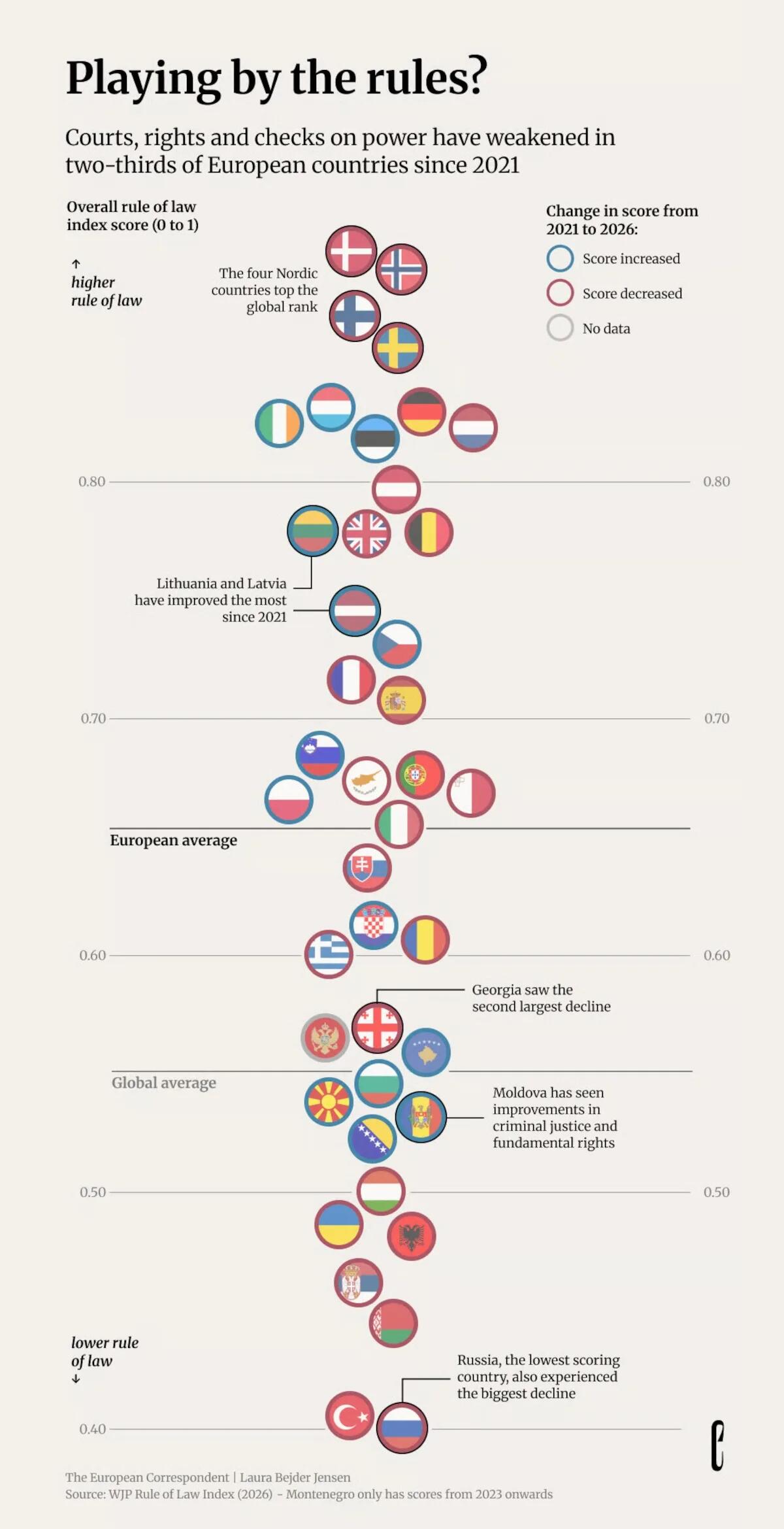
Which European Countries Have the Strongest Rule of Law?
The index measures eight factors, including constraints on government power, corruption, fundamental rights, and civil and criminal justice. Scores range from zero to one, with higher values indicating stronger adherence to the rule of law.
The following table ranks 41 European countries using data from the WJP Rule of Law Index.
| Rank | Country | Rule of Law Score (2021) | Rule of Law Score (2026) | 5-Year Change | Direction |
|---|---|---|---|---|---|
| 1 | 🇩🇰 Denmark | 0.899 | 0.898 | -0.002 | Decreased |
| 2 | 🇳🇴 Norway | 0.899 | 0.890 | -0.010 | Decreased |
| 3 | 🇫🇮 Finland | 0.878 | 0.870 | -0.008 | Decreased |
| 4 | 🇸🇪 Sweden | 0.862 | 0.857 | -0.005 | Decreased |
| 5 | 🇱🇺 Luxembourg | 0.828 | 0.831 | +0.004 | Increased |
| 6 | 🇩🇪 Germany | 0.840 | 0.830 | -0.010 | Decreased |
| 7 | 🇮🇪 Ireland | 0.808 | 0.825 | +0.016 | Increased |
| 8 | 🇳🇱 Netherlands | 0.833 | 0.823 | -0.011 | Decreased |
| 9 | 🇪🇪 Estonia | 0.807 | 0.818 | +0.012 | Increased |
| 10 | 🇦🇹 Austria | 0.812 | 0.797 | -0.016 | Decreased |
| 11 | 🇱🇹 Lithuania | 0.752 | 0.779 | +0.028 | Increased |
| 12 | 🇧🇪 Belgium | 0.792 | 0.779 | -0.013 | Decreased |
| 13 | 🇬🇧 United Kingdom | 0.785 | 0.778 | -0.007 | Decreased |
| 14 | 🇱🇻 Latvia | 0.714 | 0.745 | +0.031 | Increased |
| 15 | 🇨🇿 Czechia | 0.728 | 0.731 | +0.003 | Increased |
| 16 | 🇫🇷 France | 0.721 | 0.716 | -0.004 | Decreased |
| 17 | 🇪🇸 Spain | 0.729 | 0.708 | -0.021 | Decreased |
| 18 | 🇸🇮 Slovenia | 0.683 | 0.684 | +0.002 | Increased |
| 19 | 🇵🇹 Portugal | 0.700 | 0.676 | -0.024 | Decreased |
| 20 | 🇨🇾 Cyprus | 0.683 | 0.674 | -0.009 | Decreased |
| 21 | 🇲🇹 Malta | 0.681 | 0.669 | -0.012 | Decreased |
| 22 | 🇵🇱 Poland | 0.641 | 0.666 | +0.025 | Increased |
| 23 | 🇮🇹 Italy | 0.659 | 0.655 | -0.004 | Decreased |
| 24 | 🇸🇰 Slovakia | 0.663 | 0.637 | -0.026 | Decreased |
| 25 | 🇭🇷 Croatia | 0.608 | 0.613 | +0.005 | Increased |
| 26 | 🇷🇴 Romania | 0.627 | 0.607 | -0.021 | Decreased |
| 27 | 🇬🇷 Greece | 0.607 | 0.601 | -0.007 | Decreased |
| 28 | 🇬🇪 Georgia | 0.605 | 0.570 | -0.036 | Decreased |
| 29 | 🇲🇪 Montenegro | 0.565 | No 2021 data | ||
| 30 | 🇽🇰 Kosovo | 0.546 | 0.559 | +0.013 | Increased |
| 31 | 🇧🇬 Bulgaria | 0.541 | 0.546 | +0.005 | Increased |
| 32 | 🇲🇰 North Macedonia | 0.531 | 0.538 | +0.007 | Increased |
| 33 | 🇲🇩 Moldova | 0.512 | 0.532 | +0.020 | Increased |
| 34 | 🇧🇦 Bosnia and Herzegovina | 0.516 | 0.523 | +0.007 | Increased |
| 35 | 🇭🇺 Hungary | 0.520 | 0.500 | -0.020 | Decreased |
| 36 | 🇺🇦 Ukraine | 0.510 | 0.486 | -0.023 | Decreased |
| 37 | 🇦🇱 Albania | 0.492 | 0.482 | -0.010 | Decreased |
| 38 | 🇷🇸 Serbia | 0.494 | 0.462 | -0.032 | Decreased |
| 39 | 🇧🇾 Belarus | 0.476 | 0.445 | -0.031 | Decreased |
| 40 | 🇹🇷 Turkey | 0.419 | 0.406 | -0.013 | Decreased |
| 41 | 🇷🇺 Russia | 0.462 | 0.401 | -0.062 | Decreased |
Denmark leads with a score of 0.898, followed by Norway (0.890) and Finland (0.870). Beyond the Nordic countries, Luxembourg, Germany, and Ireland round out Europe's top seven.
Notably, Ireland and Estonia are among the few countries near the top of the ranking to have improved since 2021.
Why Are Checks on Government Power Weakening?
A strong rule of law depends on independent courts, enforceable rights, and effective limits on government authority. When these safeguards weaken, political leaders face fewer constraints on how they exercise power.
According to Liberties' 2026 Rule of Law Report, political interference in courts, weakened oversight, and fast-track legislation are undermining these protections. The organization highlighted Bulgaria, Croatia, Hungary, Italy, and Slovakia as particularly concerning cases.
Independent journalism also plays an important role in holding governments accountable, making press freedom another critical institutional safeguard.
What Does This Mean for Europe?
Weakening legal institutions can have consequences beyond politics, affecting public trust, the fairness of legal proceedings, and how governments spend public money.
A 2026 European Commission survey found that 71% of Europeans believe corruption is widespread in their country. Research from the University of Gothenburg also identifies public procurement and healthcare as sectors particularly vulnerable to corruption.
Europe continues to dominate the upper end of global rule-of-law rankings. However, the widespread declines since 2021 suggest that strong institutions cannot be taken for granted, even in countries with long-established democratic systems.