Two countries at war with each other account for more than nine in ten of the military drones that crossed borders over the past four years.
Ukraine took delivery of 8,664 foreign-supplied military drones from 2022 through 2025, most of them American, while Russia received 6,720, mostly Iranian Shahed-136s, according to SIPRI data compiled by Visual Capitalist. Taiwan, a distant third, received 291.
SIPRI's count leaves out most of what is actually flying. It tracks only large drones and long-range one-way attack models, so the cheap first-person-view drones fighting much of the war at the front don't register, and neither do drones a country builds at home.
As Visual Capitalist explains further,
Drones have become one of the defining weapons of modern warfare, and international trade in them now revolves around a single conflict.
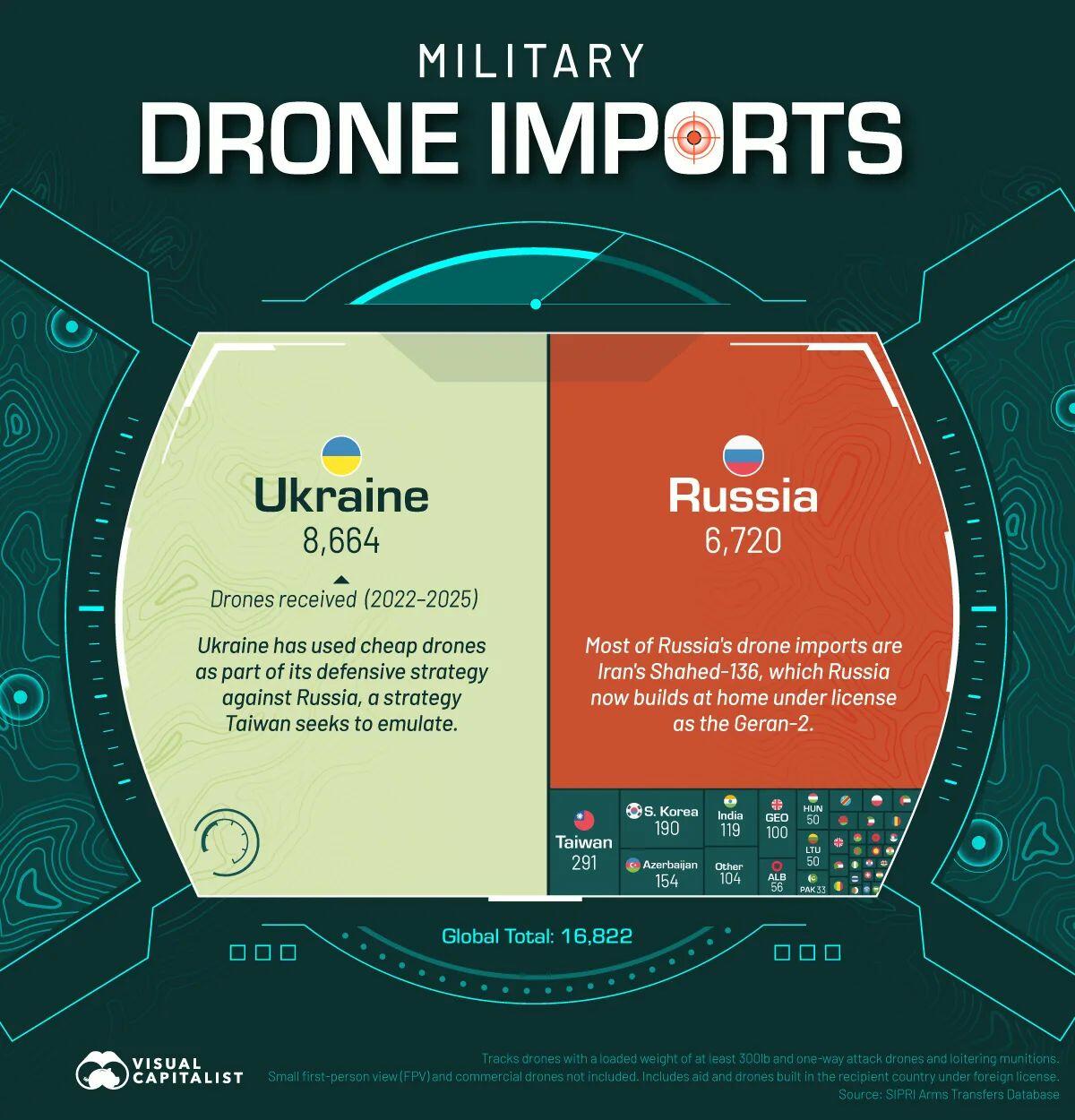
This graphic ranks countries by the number of military drones they received from foreign suppliers from 2022 to 2025, using data from the SIPRI Arms Transfers Database. The figures include drones sent as aid and those built in the recipient country under a foreign license.
SIPRI tracks major weapons only: drone aircraft with a loaded weight of at least 150 kg, plus one-way attack drones and loitering munitions, which it classifies as missiles. Small first-person-view (FPV) and commercial drones fall largely outside its scope.
Ukraine and Russia Dominate Military Drone Imports
The ranking drops off sharply after the top two countries. No other country received even 300 military drones during the period.
Ukraine's supply was heavily concentrated among U.S. systems, which accounted for 83% of its recorded total. Russia's recorded imports, meanwhile, were attributed to Iran.
The table below shows the number of military drones each country received in 2022-2025 and its share of the global total.
| Rank | Country | Military Drone Imports (2022-2025) | Share of Global Total |
|---|---|---|---|
| 1 | 🇺🇦 Ukraine | 8,664 | 51.5% |
| 2 | 🇷🇺 Russia | 6,720 | 39.9% |
| 3 | 🇹🇼 Taiwan | 291 | 1.7% |
| 4 | 🇰🇷 South Korea | 190 | 1.1% |
| 5 | 🇦🇿 Azerbaijan | 154 | 0.9% |
| 6 | 🇮🇳 India | 119 | 0.7% |
| 7 | 🇬🇪 Georgia | 100 | 0.6% |
| 8 | 🇦🇱 Albania | 56 | 0.3% |
| 9 | 🇭🇺 Hungary | 50 | 0.3% |
| 9 | 🇱🇹 Lithuania | 50 | 0.3% |
| 11 | 🇵🇰 Pakistan | 33 | 0.2% |
| 12 | 🇨🇩 DR Congo | 29 | 0.2% |
| 13 | 🇵🇱 Poland | 26 | 0.2% |
| 14 | 🇦🇪 UAE | 22 | 0.1% |
| 15 | 🇧🇾 Belarus | 20 | 0.1% |
| 16 | 🇰🇼 Kuwait | 18 | 0.1% |
| 16 | 🇷🇴 Romania | 18 | 0.1% |
| 16 | 🇬🇧 UK | 18 | 0.1% |
| 19 | 🇸🇩 Sudan | 17 | 0.1% |
| 20 | 🇲🇱 Mali | 15 | 0.1% |
| 21 | 🇧🇫 Burkina Faso | 10 | 0.1% |
| 21 | 🇲🇦 Morocco | 10 | 0.1% |
| 21 | 🇷🇸 Serbia | 10 | 0.1% |
| 24 | 🇧🇩 Bangladesh | 9 | 0.1% |
| 25 | 🇰🇬 Kyrgyzstan | 8 | <0.1% |
| 26 | 🇳🇪 Niger | 7 | <0.1% |
| 26 | 🇳🇬 Nigeria | 7 | <0.1% |
| 26 | 🇹🇭 Thailand | 7 | <0.1% |
| 29 | 🇩🇿 Algeria | 6 | <0.1% |
| 29 | 🇭🇷 Croatia | 6 | <0.1% |
| 29 | 🇰🇪 Kenya | 6 | <0.1% |
| 29 | 🇨🇭 Switzerland | 6 | <0.1% |
| 29 | 🇹🇯 Tajikistan | 6 | <0.1% |
| 34 | 🇽🇰 Kosovo | 5 | <0.1% |
| 34 | 🇸🇦 Saudi Arabia | 5 | <0.1% |
| -- | Other | 104 | 0.6% |
| -- | Global Total | 16,822 | 100.0% |
Most of Russia's drone imports were Shahed-136s, which Russia first imported from Iran and now produces in its own versions as the Geran-2. SIPRI says there is little indication that continued Iranian input is still needed.
Small Military Drone Trade Is Far Bigger
Outside Russia and Ukraine, Taiwan is the largest importer of military drones, with 291 U.S.-made loitering munitions delivered in 2025.
Its drone push has been influenced by Ukraine, and government plans call for up to 200,000 drones over the coming decade, more than 10 times the entire global total recorded from 2022 to 2025.
This gap exists because SIPRI's database, the same one behind our ranking of the biggest arms importers, tracks major weapons: large drones plus long-range one-way attack drones, with the latter making up 97% of the transfers shown here. The small, inexpensive first-person-view (FPV) drones that now do much of the fighting at the front mostly fall outside its scope.
Those drones move in far larger numbers. The UK alone delivered more than 85,000 smaller military drones to Ukraine in six months of 2025, about five times SIPRI's recorded global total for the entire four-year period.
Drones built domestically are also excluded, since SIPRI only counts weapons that cross borders or are produced under a foreign license. Ukraine's defense industry can now produce more than 8 million FPV drones a year, while Ukrainian intelligence estimates that Russia builds about 2,800 Geran-2 drones per month, far above the 2,000 a year SIPRI records under the Iranian license.